Decode on the official weights
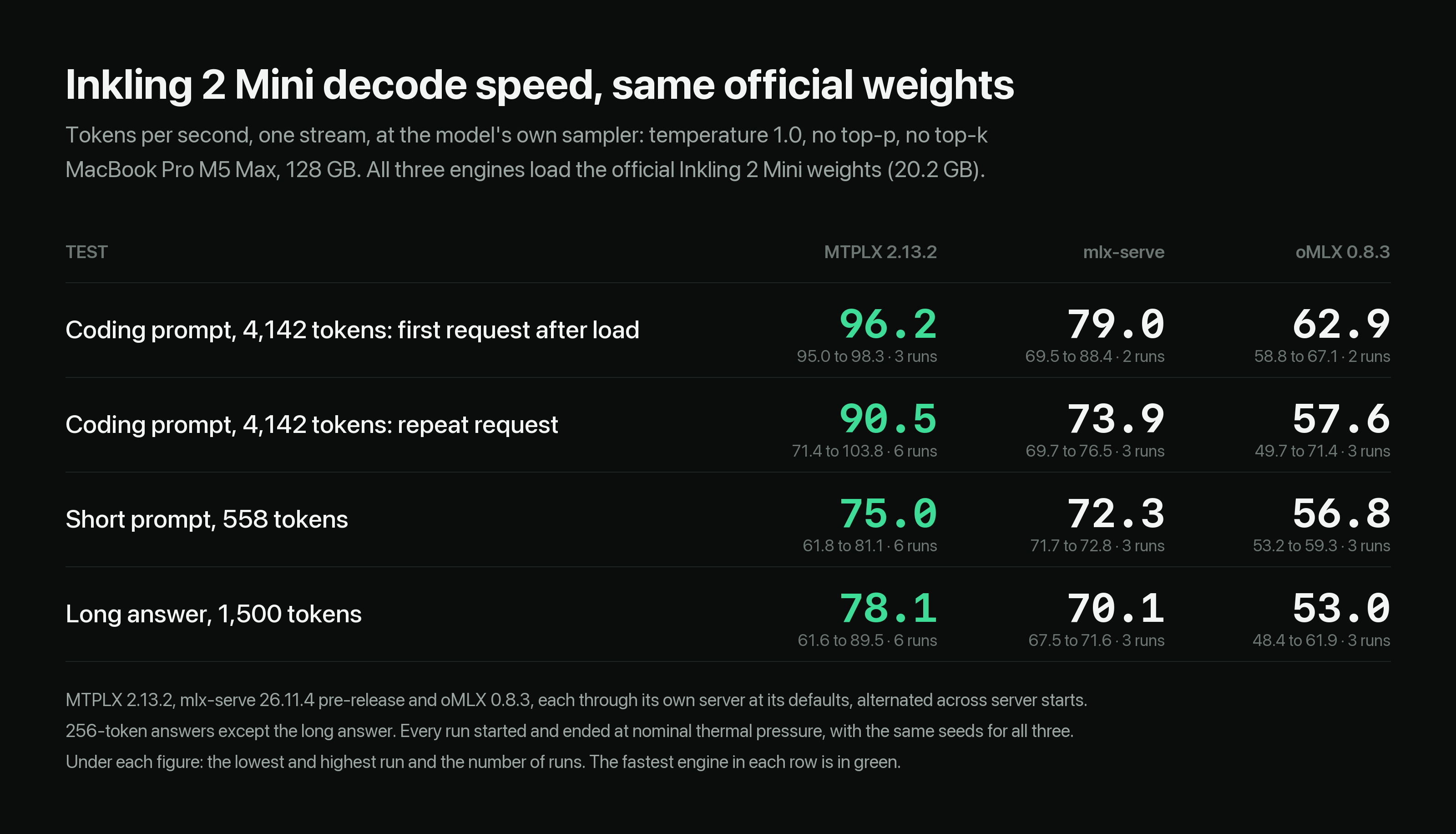
All engines loaded the same 20.2 GB official weights. Decode is in tokens per second. Each cell gives the mean, the lowest and highest run, and the run count. The summary gives each test equal weight.
| Test | MTPLX Optimized Quality 20.2 GB | mlx-serve official weights 20.2 GB | oMLX official weights 20.2 GB |
|---|---|---|---|
| Coding prompt, 4,142 tokens, first request after load | 96.2 95.0 to 98.3 3 runs | 79.0 69.5 to 88.4 2 runs | 62.9 58.8 to 67.1 2 runs |
| Coding prompt, 4,142 tokens, repeat request | 90.5 71.4 to 103.8 6 runs | 73.9 69.7 to 76.5 3 runs | 57.6 49.7 to 71.4 3 runs |
| Short prompt, 558 tokens | 75.0 61.8 to 81.1 6 runs | 72.3 71.7 to 72.8 3 runs | 56.8 53.2 to 59.3 3 runs |
| Long answer, 1,500 tokens | 78.1 61.6 to 89.5 6 runs | 70.1 67.5 to 71.6 3 runs | 53.0 48.4 to 61.9 3 runs |
| Average of the test means | 85.0 | 73.8 | 57.6 |
View the official weights table as an image
Decode on each engine’s fast pack
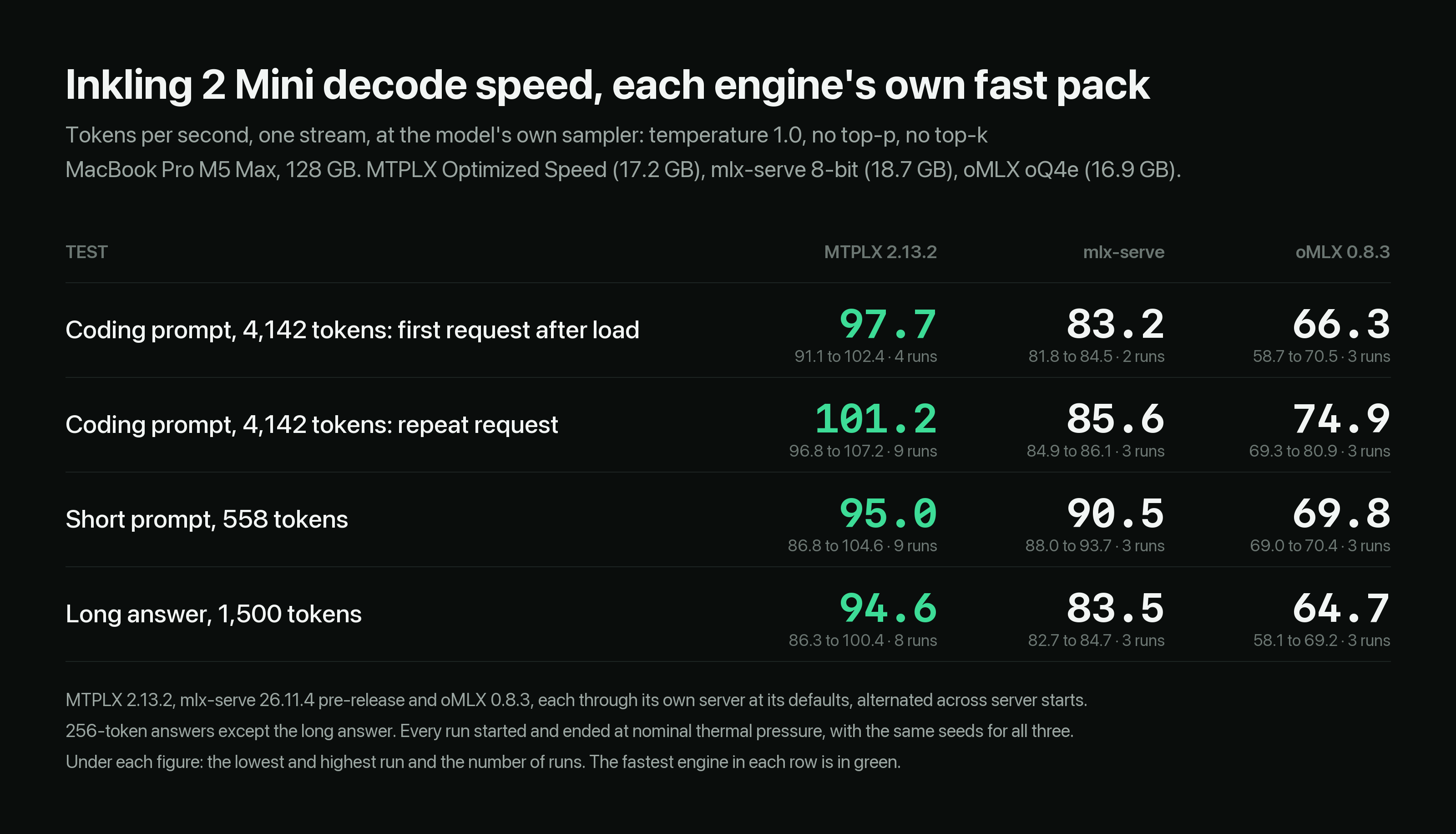
Here each engine used its own fast pack. The column headings give the pack name and size.
| Test | MTPLX Optimized Speed 17.2 GB | mlx-serve 8-bit 18.7 GB | oMLX oQ4e 16.9 GB |
|---|---|---|---|
| Coding prompt, 4,142 tokens, first request after load | 97.7 91.1 to 102.4 4 runs | 83.2 81.8 to 84.5 2 runs | 66.3 58.7 to 70.5 3 runs |
| Coding prompt, 4,142 tokens, repeat request | 101.2 96.8 to 107.2 9 runs | 85.6 84.9 to 86.1 3 runs | 74.9 69.3 to 80.9 3 runs |
| Short prompt, 558 tokens | 95.0 86.8 to 104.6 9 runs | 90.5 88.0 to 93.7 3 runs | 69.8 69.0 to 70.4 3 runs |
| Long answer, 1,500 tokens | 94.6 86.3 to 100.4 8 runs | 83.5 82.7 to 84.7 3 runs | 64.7 58.1 to 69.2 3 runs |
| Average of the test means | 97.1 | 85.7 | 68.9 |
View the fast packs table as an image
Time to first token and cold prefill
We timed the first token on the 4,142-token coding prompt after load and on a repeat request. A shorter time is better. For cold prefill, a higher token rate is better.
| Pack and test | MTPLX | mlx-serve | oMLX |
|---|---|---|---|
| Official weights First request (s) | 1.78 1.66 to 2.02 3 runs | 1.53 1.52 to 1.54 2 runs | 2.54 2.49 to 2.58 2 runs |
| Official weights Repeat (s) | 0.81 0.72 to 0.90 6 runs | 0.19 0.18 to 0.19 3 runs | 0.21 0.21 to 0.21 3 runs |
| Official weights Cold prefill (tok/s) | 2,532 3 runs | 2,811 2 runs | 1,999 2 runs |
| Fast packs First request (s) | 1.72 1.62 to 2.00 4 runs | 1.54 1.53 to 1.54 2 runs | 2.84 2.55 to 3.35 3 runs |
| Fast packs Repeat (s) | 0.79 0.71 to 0.90 9 runs | 0.18 0.18 to 0.18 3 runs | 0.20 0.20 to 0.20 3 runs |
| Fast packs Cold prefill (tok/s) | 2,624 4 runs | 2,782 2 runs | 1,806 3 runs |
Where the other engines are ahead
On the cold 4,142-token prompt with the official weights, mlx-serve returned the first token in 1.53 s and MTPLX took 1.78 s. On the repeat request, mlx-serve took 0.19 s, oMLX 0.21 s and MTPLX 0.81 s. mlx-serve also read the cold prompt faster, at 2,811 tok/s against 2,532 for MTPLX.
We did not test concurrent requests or other Macs.
How this was measured
On 23 November 2026, we tested MTPLX 2.13.2, mlx-serve 26.11.4 pre-release and oMLX 0.8.3 on a MacBook Pro M5 Max with 128 GB, using one stream at the model’s own sampler (temperature 1.0, no top-p, no top-k).
We alternated server starts and sent the same prompts and seeds (29, 31, 37) to each engine’s own server at its defaults. We requested 256-token answers except for the 1,500-token answer. Every run started and ended at nominal thermal pressure. We timed decode at the client from the first token.
We sent the 4,142-token coding prompt after load and then repeated it. The short prompt had 558 tokens. The benchmark file contains 162 valid measurements. Each table shows the run count for each mean.
We tested Inkling 2 Mini (Thinking Machines Lab), official weights revision 6e7c8248. The benchmark JSON contains the measurements.
Frequently asked questions
What is the fastest way to run Inkling 2 Mini on a Mac?
MTPLX with Optimized Speed had the fastest decode in our single-stream M5 Max tests. The fast packs averaged 97.1 tok/s for MTPLX, 85.7 tok/s for mlx-serve and 68.9 tok/s for oMLX. With the official weights, the averages were 85.0 tok/s for MTPLX, 73.8 tok/s for mlx-serve and 57.6 tok/s for oMLX.
Is MTPLX faster than mlx-serve?
Yes for single-stream Inkling 2 Mini decode on our M5 Max. The official weights averaged 85.0 tok/s for MTPLX and 73.8 tok/s for mlx-serve, and their fast packs averaged 97.1 tok/s for MTPLX and 85.7 tok/s for mlx-serve. On the repeat request with the official weights, mlx-serve returned the first token in 0.19 s against 0.81 s for MTPLX.
Is MTPLX faster than oMLX?
Yes for single-stream Inkling 2 Mini decode on our M5 Max. The official weights averaged 85.0 tok/s for MTPLX and 57.6 tok/s for oMLX, and their fast packs averaged 97.1 tok/s for MTPLX and 68.9 tok/s for oMLX. On the repeat request with the official weights, oMLX returned the first token in 0.21 s against 0.81 s for MTPLX.
Is mlx-serve faster than oMLX?
Yes for single-stream Inkling 2 Mini decode on our M5 Max. The official weights averaged 73.8 tok/s for mlx-serve and 57.6 tok/s for oMLX, and their fast packs averaged 85.7 tok/s for mlx-serve and 68.9 tok/s for oMLX.
Which engine is fastest on the official, unquantised weights?
MTPLX had the fastest decode on the official weights in our M5 Max tests, which averaged 85.0 tok/s for MTPLX, 73.8 tok/s for mlx-serve and 57.6 tok/s for oMLX. All three engines loaded the same 20.2 GB release, which already contains quantised experts. We did not test a separate unquantised checkpoint.